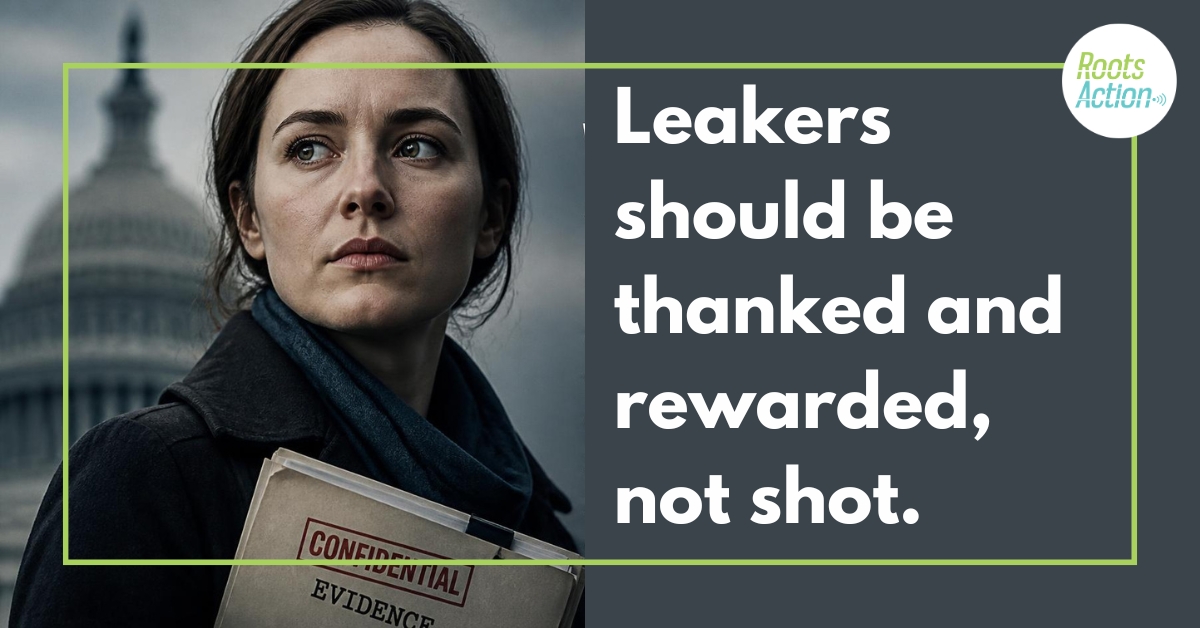
RootsAction Whistleblower Advocate Jeffrey Sterling spent two-and-a-half years in prison after being convicted of violating the Espionage Act. No incriminating evidence was produced at his trial. His reaction to Trump's latest comments follows:
The man who controls the Justice Department, the intelligence agencies, and the military said, on camera, that people who disclose government secrets should be put to death.
I wish I could tell you this was a slip. It isn’t. It's part of a pattern. In 2013, Trump said Edward Snowden “should be executed.”2 In 2019, when a whistleblower came forward about the Ukraine call, Trump told staff at the U.S. mission to the U.N. the whistleblower was “close to a spy,” and added: “You know what we used to do in the old days... with spies and treason, right?” Reportedly, whoever leaked his 2020 White House bunker stay “should be executed.”3
And last week, the President supported the first firing-squad execution of a U.S. soldier since World War II, and showed enthusiasm for broadcasting it. Only after bipartisan backlash did Trump reverse himself. When the idea of a televised execution gets seriously discussed at the highest levels of power, that tells you how real the threat has become.
Each time, people called it hyperbole. But a pattern of statements eventually becomes a statement of intent. And this administration is already acting on the part it can: the Pentagon has put dozens of employees through polygraph tests to hunt for leakers, the FBI has raided a reporter’s home, and the Justice Department has charged an alleged leaker who spoke to a journalist.4, 5, 6
To Trump, a leaker and a whistleblower are the same thing. So is the law he would use. The Espionage Act has no public-interest defense. It doesn’t ask whether you exposed fraud, an illegal program, or a lie told to the public. In practice, you can’t tell a jury why you did it. On paper, the person who reveals wrongdoing and the person who sells secrets look identical. That’s why this threat is aimed at every whistleblower in government, whether or not Trump understands the difference.
And here is what he leaves out.
Donald Trump was indicted on 31 counts of willful retention of national defense information under the Espionage Act.7 If a leaker “should be shot,” where does that leave the man the government charged with taking top-secret documents home? He was never held to account. A judge he appointed dismissed the case, and it ended for good after he won the election. The punishment he demands for others never touched him.
I know the other side of that double standard, because I lived it. I was a CIA whistleblower. I was prosecuted under the Espionage Act and convicted in a trial where the government never produced direct evidence that I committed a crime.
I know what it is to have the full weight of the United States government come down on one person. I know what it does to your career, your family, your freedom, and your life. I got a prison sentence. Now the President is telling a cheering crowd that the next person should get a bullet. Think about what that does to the next person.
Whistleblowers are how the public learns about fraud, abuse, illegal wars, and corruption. They are almost never heroes in their own minds. They’re people with a mortgage, a family, and a conscience, who saw something wrong and couldn’t look away. When the President says they should be shot, the next one with evidence of wrongdoing has to ask whether speaking up is worth their life, not just their career.
That is the point of the threat. It doesn’t have to be carried out to work. It only has to be believed.
We can’t let it work.
Will you donate what you can?