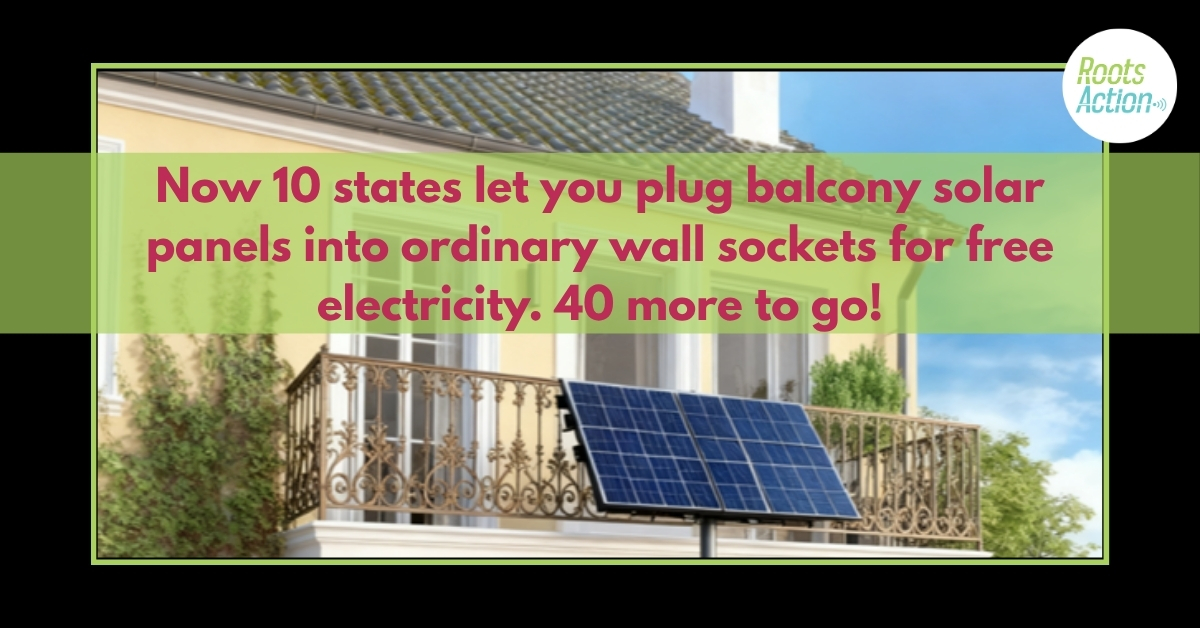
These balcony or plug-in solar laws allow people to plug small solar panels on balconies or patios into ordinary outlets for enough electricity to run their home appliances without paying any power company for it — just as millions of people had long been able to do in Germany and other countries.
After Utah's success, RootsAction began generating thousands of emails from local residents to the legislators and governors of each state still in need of this policy.
See: https://rootsaction.org/allow-balcony-solar
According to Canary Media's tracking of this legislation, Pennsylvania's legislature is considering a similar measure, while bills in New York and Massachusetts await only a governor's signature.
https://www.canarymedia.com/articles/solar/states-passing-balcony-solar-laws
"Governments at every level should be investing massively in solar and wind energy," said RootsAction campaign coordinator David Swanson. "If we could harness the hot air from every conversation about competing with China and put it into the sorts of renewable energy projects China is working on, that could work wonders for the world — possibly even for peace, given the impossibility of sunshine getting blocked in the Strait of Hormuz.
"Of course, choosing a Green New Deal over a war is a matter for the federal government, but states can allow us to plug in solar energy at our own houses, with no public investment, just the correcting of bad laws that get in the way."
Balcony solar panels can provide enough power for residents to run, free of charge, home appliances such as fridges, dishwashers, washing machines and wi-fi without spending money on electricity from the grid. The panels are smaller than standard rooftop panels and can be zip-tied in place without professional installation.
They are blocked by state laws — laws that typically require anyone who installs solar panels to strike an agreement with the local utility for the power they are feeding back to the grid. The installation of panels also typically has to be done by contractors and be inspected. Utah simply carved out an exemption from interconnection agreements for people generating 1.2 kilowatt of power or less. Other states are, one-by-one, doing the same.
RootsAction is a nonpartisan action organization working since 2011 to defend the public interest and expand social justice. RootsAction is dedicated to galvanizing people to promote economic fairness, equal rights for all, civil liberties, environmental protection, and defunding endless wars. RootsAction advances this work at the national and state levels without partisan fear or favor, and with a long and growing list of successes.
https://rootsaction.org